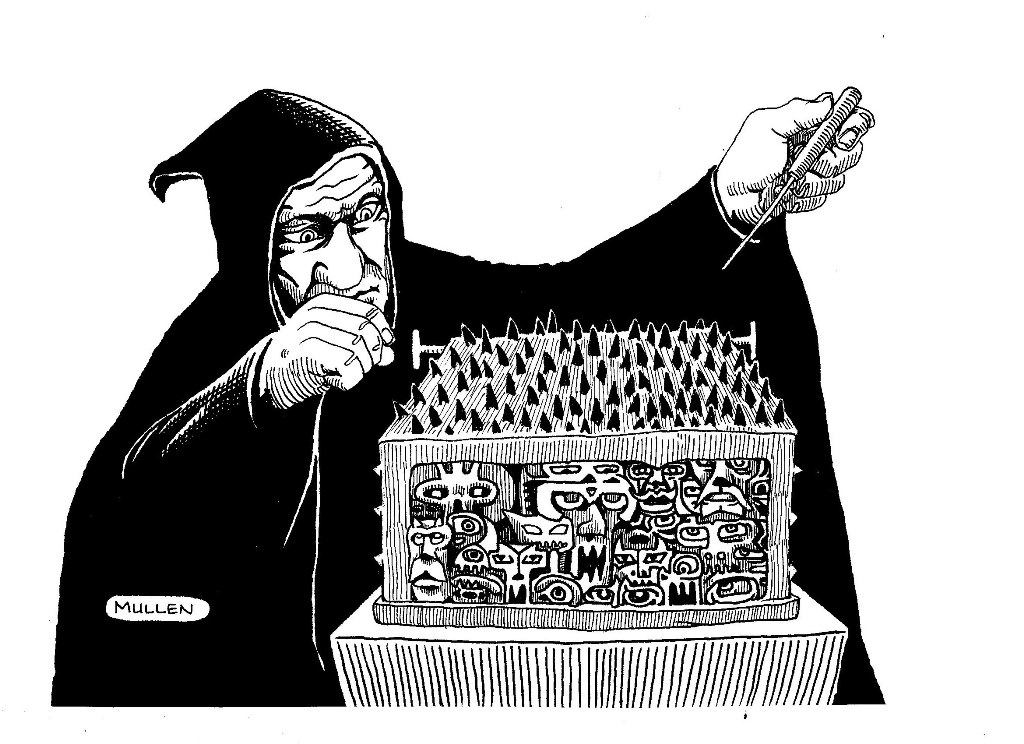
B/X Thieves are infamously known for being the weakest class in the line up. D4 hit die, leather armor being the highest tier armor they can wear, and a list of skills that are borderline useless for a majority of your play sessions.
Despite this, the flavor and vibe of playing a Thief is one of the most popular in modern fantasy history. If we are talking about the classics see no further than The Mouser of Lankhmar, Silk from the Belgariad, Arsène Lupin the Gentlemen Burglar, Robin Hood, Cudgel the Clever and last but not least Bilbo Baggins of the Shire. Some more modern classics carry this legacy, such as Locke from Final Fantasy 6, Garret from Thief: the Dark Project, Sly Cooper, and Joker of Persona 5.
The Origins of the Thief
The Thief class was originally developed by the Aero Hobbies crowd in Santa Monica, California after they called up Gygax on the telephone and shot the shit with him on the concept, so you can thank Bob Switzer and Daniel Wagner for the Thief class we have today.
At a later point, Gygax tweaked and created his own Thief class from the bones of Switzer/Wagner’s Thief and thus was released in Supplement 1: Greyhawk for OD&D in March of 1975. Allegedly, Gygax came up with the percentage style chance of success for the Thief’s skills and the Backstab multiplier which now has become a divisive topic amongst the OSR crowd.

The Thief’s Impact on Old School D&D
Prior to the Thief’s release, the 3 other character classes (Cleric, Fighting Man, and Magic User) didn’t have a list of skills that they could use like the Thief’s percentile based skill system, the only thing they had in common was the x – in – 6 rolls to preform mundane tasks like listening at doors and the like. The Thief’s inclusion to the Core 3 has split the modern player base, with people either loving or hating the Thief.
Said Thief haters believe that by adding these percentile skills that it changed the playstyle of the game from a more descriptive/fiction focused playstyle to that of something akin to modern D&D with the player character’s sheet being occupied by a list of abilities they refer to when playing the game. These players believe that when incorporating these aspects that it takes away from the player’s investment and immersion while also causing confusion for the other classes, as prior to the Thief’s release, the party regardless of class were sneaking, cracking open locks, foiling traps, and the like. Why shouldn’t a Fighter be able to do the things a Thief can do? Is sneaking not a useful skill that any character class can utilize? Would a Back-Attack from a non-Thief not be as equally effective?
Arguably, there is a distinction between the Thief’s abilities and that of the non-Thief’s attempt at trying the same thing. The Thief’s Find/Remove Trap ability is a notable one; commonly mistaken for finding and removing room traps like pressure plates and such. In reality, it’s intended for small mechanical traps like poison needles (as detailed in Greyhawk Supplement).
Another difference is made with the inclusion of Move Silently and Hide in Shadows. I’d like to believe that the phrasing of Move Silently implies that no sound can be heard at all when successful, which gives a preternatural edge to the Thief’s abilities. Likewise with Hide in Shadows, you can’t move once you’re hidden but I imagine they meld into whatever shadows blot a room and become practically invisible if successful.
With this information, it’s really up to taste and preference whether you want to include Thieves or remove them entirely. I’d say removing them gets rid of the following issues I end up detailing below, but some people just love the archetypal thief so much and find them to be the missing quarter of a whole for the party dynamic that they can’t help but adore them.
The Thief’s Impact on Modern Media
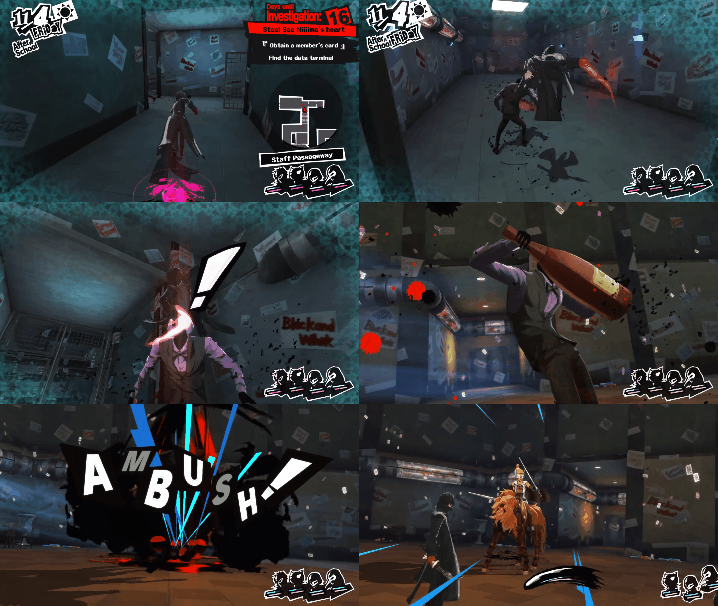
If comparing the playstyle of the Thief in D&D to that of thieves in popular video game media, in certain ways they’ve both inspired one another. In Thief: the Dark Project, combat is generally a last resort option as Garret is weak and frail relative to the guards and brutes that patrol the castles he stalks. Likewise with Sly Cooper, getting caught in certain sections of the game results in immediate game overs or retries, especially in the 1st game where Sly can lose a life to just one hit from basic enemies. Lastly, in Persona 5 (and the rest of the prior games mentioned), it’s best to stay out of obvious spot light paths and enemy patrols as they often result in unwanted face to face encounters. Fighting enemies head on in all of these games tends to be the more challenging experience as thieves stereotypically have been established to be weaker in head to head combat. Ideally, you want to ambush the patrols to get the first turn in Persona, or to just avoid interaction entirely like in T: TDP.
Garret is known for his abundant access to nifty tools and gadgets which help him to get around places stealthily – such as Water Arrows to douse torchlight, Rope Arrows to make climbing place easier, Wrenches and Wire cutters to disable pesky traps, and so on. The major appeal of playing Thief is the open-endedness of the levels and the ability to preform the heists of each level in a different way every time, as the level design supports up to 3 or more possible ways to get into buildings, either thru gatehouses, sewer systems, or scaling walls. The art of being a Thief lies more in wit, available information and the Thief’s access to useful tools than their inherit power.
With the tropes of casing a joint, sneaking around in shadows, being careful to avoid patrols and torch-light, and ambushing the unaware, we now have a framework for the expectations of a Thief. A Thief being one who’s –
A. Weak in direct head to head combat; ideally taking their foes by surprise with attacks from behind.
B. Excels at casing joints to find sneaky entrances, secret passages and are acrobatic enough to climb or sidle into places typically unreachable by non-thief types.
C. Using tools and gadgets to more easily traverse dungeons, crack open locks, disarm traps and to maintain their stealthy nature.
These are the 3 major core aspects of fulfilling the Thief archetype and as D&D players love to play this role in the core party of four, doing so from 1st level in B/X is not an easy task.
The Inadequacy of the Thief
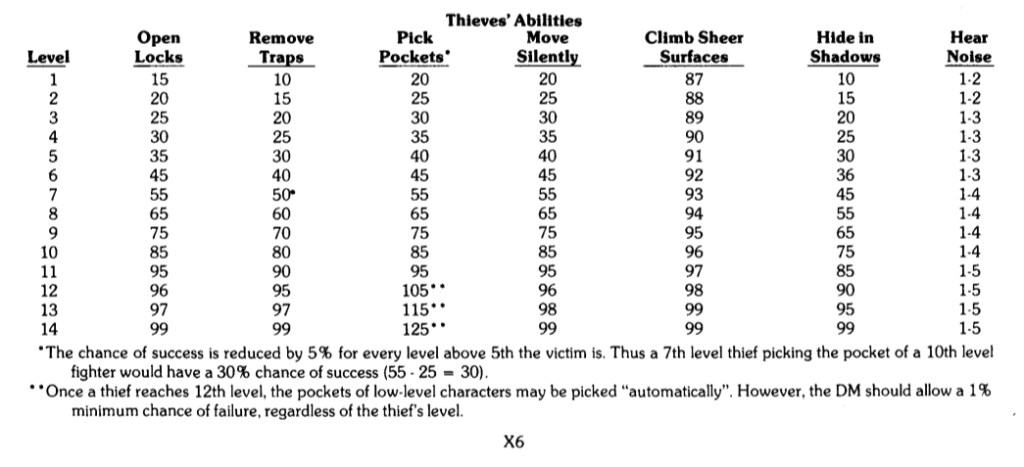
Here is the Thief Abilities chart as depicted on page X6 in Moldvay Expert. As you can see, the odds of success on these checks are minuscule if just playing the game straight from the book. Only a Thief of 7th level seems adequately efficient enough to preform the feats of our prior mentioned fantasy heroes, and by that point, the party is probably a year into play given the amount of exp required to reach 7th level.
If you were to compare the capabilities of a 1st level Rogue in D&D 5e (2014) to our B/X Thief, if they choose to be proficient and have expertise in Stealth, Sleight of Hand, Acrobatics and their Thieves’ Tools, they’d probably be nearly as effective as a 8th level Thief in B/X at minimum. Say the Rogue has a +4 to DEX and is proficient in these skills, they’d likely have +6 to +8 when making those skill checks, and if the average difficulty of a check is 15 (being medium difficulty), they only need a 7-9 on a d20 to succeed (a 60-70% chance). The average low level monster in 5e also has a relatively low Passive Perception, such as Goblins with a score of 9, Grimlocks with 13, Hobgoblins with 10, Kobolds with 8, and Orcs with 10.
With this understanding, it’s no wonder the Thief doesn’t see much play. Even if you aren’t explicitly using the Thief skills it’s considerably better to play a Halfling or a Dwarf Class (in B/X) for both their dungeon utility, base skills and saving throws with only someone with impressive ability scores being able to make up for the lackluster power of a 1st level Thief and in OD&D, every demi-human race gets bonuses to the percentile Thief skills that makes them noticeably better than starting as a generic human, and none of them have a level cap for playing a Thief unlike the other classes demi-humans can choose. “Furthermore, dwarves, elves, half-elves, or hobbits may be thieves, and in this class there will be no limit to their continuing to advance to the highest levels.” -page 4 of Supplement 1: Greyhawk (1975).
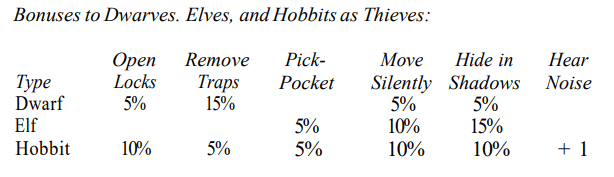
You could argue that because it is believed that 5e D&D is more so meant to achieve Superheroic levels of gameplay vs. OSR style plain ol’ heroic, that it explains the drastic difference between their abilities. However, the Rogue and the Thief aren’t doing anything particularly different from one another in execution that isn’t separated by chance of success. The modern Rogue isn’t warping reality with magic to make himself more stealthy at 1st level. If anything, the B/X Thief is more preternatural with their ability to climb sheer surfaces with ease, move silently (I imagine moving silently is moving without making any noise), and to hide in shadows. The 5e Rogue really just has a lot of these abilities compacted down into Acrobatics and Stealth, neither of which are particularly described as supernatural vs. the more evocative phrasing of Hide in Shadows.
So – what now? How can we pull the Thief in line with the other classes and make them both a viable option and a fun character choice for both new and old players?
Step 1. Variable Difficulty
One way a DM could adjust the game to be more favorable is by giving variable difficulty adjustments to the listed Thief Abilities depending on in-game scenarios.
You could use 5e D&D as a framework for this by taking inspiration from the table of Difficulty Classes.
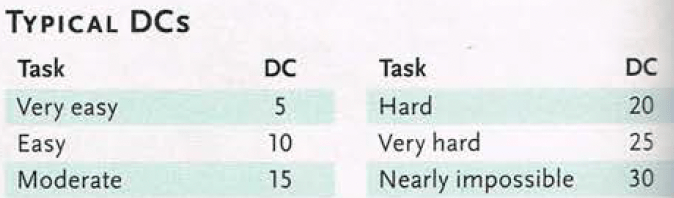
You could on-the-fly adjust the Thief’s chance of success by giving bonuses or penalties in percentage form. A DC 5 Task being labeled as Very Easy could be interpreted as a +75% bonus, Easy as +50%, Moderate as +25% and Hard and higher difficulties as unmodified or impossible to attempt. I would, however, highly suggest that if a task could be completed in a reasonable time and without much difficulty, the Thief should not require a skill check at all.
Say for example a Thief attempts to climb a castle wall that’s composed of cobblestone blocks, hanging vines, stone pedestals, flag poles, and gargoyle statues. Given the time and equipment the Thief has on hand, I would personally rule that it would require no roll at all to climb up such a building as the environment is suited to the Thief’s expertise.
In a nearly identical scenario, but with a few adjustments, say this castle is darkened by nightfall, slippery due to rainfall, and made of difficult to climb material, then a Climb Sheer Surfaces check should be rolled, either with just the base chance of success or adjusted by circumstance.
I’m sure you’re creative enough to come up with similar scenarios for the other Thief skills, like low quality or aged padlocks being easier to lockpick than more intricate Dwarvencraft locks, carpeted rooms of the castle being easier to move silently on, and dark corridors or dark forests to hide in the shadows easier.
Lastly, you could implement a percentage increase in success by how much time a Thief decides to put into a task. Say for example they’re trying to get into a highly protected vault with a complex lock mechanism. The Thief could ask his party to stay on guard as he attempts a long marathon of lock picking, passing 20 or 30 minutes, and potentially gain a +10% bonus for each Turn he takes to try to crack the lock. Eventually with enough persistence the Thief could open the vault and isn’t reduced to one singular attempt per entire experience level as adjudicated in the books.
Step 2. Connections and Gadgets
With our prior mentioning of Garret from Thief, he is no more than a mundane man fueled by experience, information and the adequate tools for the job. You could imagine that a thief within your own D&D setting or campaign might have contacts or guilds they may report to for assignments or information on potential heists or delves. Thieves’ Guilds should be utilized more often with players, even non-Thieves should try to get in touch with them as they’d have valuable information for just the right price or job.
With that being said – Thieves should bargain with the guilds brokers and fences to get better deals on relics found in the dungeon, maps from previous delvers, specialized equipment for Thief jobs, and or rare one-time-use magic items that may make the job a sinch.
Here’s a few items that I thought up that could be used by Thieves to increase their odds of success when preforming their Thieving Abilities. Feel free to include or exclude certain items depending on how much power you wish to potentially give Thieves in your game. The items include a Usage Die mechanic tooling as I find it easier to keep track of equipment that way.
Climbing Chalk
10gp per Small Pouch worth of Chalk
4 Uses or (1d6>1d4 Usage Die)
Takes up 1 Equipment Slot, or 100 coins
When the Thief attempts to Climb Sheer Surfaces, if they take 10 minutes to prepare ahead of time by chalking their palms for better grip, they get a +5% chance to successfully climb.
Climbing Cleats / Spidersilk Boots
25gp per pair of cleats / 50gp per pair of silken boots
4 Uses or (1d6>1d4 Usage Die)
Takes up 1 Equipment Slot, or 100 coins
When the Thief attempts to Climb Sheer Surfaces, if they take off their mundane boots and put on the cleats, they get a +5% chance to successfully climb, as the cleats let them get better foot holding. If using Spidersilk Boots, they get a +10% chance to successfully climb, but if the surfaces the Thief steps on are wet, muddy or metal grated they are treated as ineffective.
Grapnel Gun
30gp Micro-Grappling Hook mounted Light Crossbow
Takes up 1 Equipment Slot, or 100 coins
1d4 damage, Missile (5’–80’ / 81’–160’ / 161’–240’), Reload, Slow, 2H
Can be used to fire a 50′ length of rope from a specialized singular crossbow bolt tipped with a smaller form of a grappling hook. The shot can be fired up to 160′ into the air with no penalty, but anything higher requires either a successful missile attack vs. an AC of 10 or 10 minutes to get a successful grapple. When set-up, gives the Thief a +5% chance to successfully climb.
Any failure of missing the missile attack induces a Usage Die roll starting at 1d6 usages and when depleted means the grapple hook has chipped or broken.
Brass Listening Cone
25gp per Trumpet
Takes up 1 Equipment Slot, or 100 coins
Can be used to press against dungeon doors, walls, and the like to receive a +1 bonus to Hear Noise. Can be used to hear for monsters, running water, hollow walls that hide secret doors, etc.
Trick Revealing Powder
50gp per use
1 Use
Takes up 1 Equipment Slot, or 100 coins
A bag of arcane powder that can be blown from the palm or applied with a brush to find traps, secret doors, hidden wires or invisible objects. The objects when applied with the powder shimmer in torch light.
Dowsing Rods
50gp per pair of rods
Takes up 1 Equipment Slot, or 100 coins
A pair of rods that when used for 10 minutes gives a +1 bonus to finding Secret Doors, locating water, traps, and or maligned earthly vibrations. When successful, the Rods seem to vibrate in the hands of the Thief, with being further away from a potential secret generating a small rumble versus a heavy vibration when closer to findable secrets. Loud vibration may alert nearby monsters on a 1/6 chance.
Hushwraps
100gp per pair of footwraps
Takes up 1 Equipment Slot, or 100 coins if not worn
Footwraps that when worn (with shoes off) make the step of the Thief more delicate and quiet, giving the wearer a +50% bonus to Moving Silently. It takes 10 minutes to put them on, and they provide no padding or foot protection, so any harmful objects the Thief may step on may result in unwanted potential detection.
Gloomcloth Shroud
150gp per Shroud
Takes up 1 Equipment Slot, or 100 coins if not worn
A pitch-black cloak crafted by elven artisans to improve hiding in shadows. The wearer, when fully wrapped and concealed in the shroud gains a +50% bonus to hiding, but at the cost of vision for the wearer. The cloak is so dark that the wearer cannot see through it.
Ghillie Suit
100gp per Suit
Takes up 2 Equipment Slots, or 200 coins if not worn
When attempting to Hide in Shadows in heavily Forested terrain or Jungles, the wearer gains +50% bonus to their Hide ability check, but cannot move as per the rules of Hide in Shadows. The suit is cumbersome, and requires 10 minutes to put on.
Charcoal Facemask
20gp
4 Uses or (1d6>1d4 Usage Die)
Item is discrete and small so takes up no bag space
After 10 minutes of preparation the charcoal is applied to the face, allowing the skin of the wearer to meld more easily with darkness, giving them a +25% bonus to Hide in Shadows.
Soot Bomb
75gp per Pouch
1 Use
Takes up 1 Equipment Slot, or 100 coins
Missile (5’–10’ / 11’–20’ / 21’–30’)
A small pouch full of soot, that when thrown causes the effects of a Darkness spell centered on it’s landing location. The soot remains floating in the air for 1d2 Turns and can be blown away with a strong wind.
Flash Powder
75gp per Vial
1 Use
Takes up 1 Equipment Slot, or 100 coins
Missile (5’–10’ / 11’–20’ / 21’–30’)
A small vial full of granular reflective arcane dust, that when thrown activates a magical pyrotechnics display that blinds and disorients (Light spell) anyone within a 10′ radius centered on it’s landing location. Those outside of this range who witness the explosion have a 1-2/6 chance of being blinded (including yourself and your allies).
Dousing Darts
10gp per Dart
1 Use Darts, when recovered are treated as typical 1d4 darts
10 coins per Dart, or 10 Darts per Equipment Slot
Missile (5’–10’ / 11’–20’ / 21’–30’)
Small, feather-finned darts with tips covered in an fire-retardant substance that when thrown can douse small flames like candle or torch-light. However, the clinking of the darts with the nearby wall or floors when it lands may attract nearby monsters on a 1-2/6 chance.
Dwarven Cranktop
75gp per Top
Multiple Uses if recovered, malfunctions on a 1/6 every time it’s thrown or (1d6>1d4 Usage Die)
Takes up 1 Equipment Slot, or 100 coins
Missile (5’–10’ / 11’–20’ / 21’–30’)
A Dwarven toy noisemaker that can be cranked and thrown or rolled to cause a ruckus as it’s gear mechanisms click and grind to make a loud sound.
May attract a random encounter on a 4/6 chance, and a Thief attempting to Move Silently nearby the noisemaker has a +50% bonus to said ability check.
Shardbinding Gel
50gp per container
1 Use or (1d4 Usage Die)
Item is discrete and small so takes up no bag space
The gel can be smeared along a window of reasonable size that when broken and pushed in, when the glass lands it stays together and reduces the sound of the impact had it been broken normally. If a monster is nearby, they have a 1/6 chance of hearing the gel-smeared glass landing if the surface it lands on isn’t soft, versus a potential higher chance of detection had it not been smeared at all.
Scroll of Ventriloquism
150gp per Scroll
1 Use
Can be used to cast the Magic User spell Ventriloquism, written in arcane-infused Thieves’ Cant that can only be read by Thieves to recite the spell.
Ball Bearings
10gp per pouch
1 Use
you can spill these tiny metal balls from their pouch to cover a level, square area that is 10 feet on a side. A creature moving across the covered area must succeed on a Saving Throw vs. Breath Weapons or fall prone for 1 Round. A creature moving carefully through the area at half speed doesn’t need to make the save.
Step 3. Thief Ability Point Buy
When looking at the Thief’s list of percentile chance of Abilities, if you were to suck out the points and add them all up you’d have about.. 162 points.
With this in mind, adding together the percentile chance of 2nd level, you get 188 points, 214 points at 3rd, and so on. If you subtract these numbers from each other incrementally, you get about 26 points gained per Thief level.
So – lets cut to the chase. Start your Thief player with a pool of 156 Ability Points with 6 points subtracted from the base total (162) to give each skill a base of 1%. Let them apply the points as they like, and every time they level up let them apply 26 more points to any of their skills so that they can tailor their Thief to the type of archetype or skillset that they enjoy.
This method retains the same percentage odds chance that a typical Thief would have at 1st level, as they aren’t getting cheated any more or less points than what they would have spread across their available skills widely. I can imagine in the D&D world that Thieves would vary in skill and expertise, so some Thieves may be suited to infiltration with better Climb and Pick Lock skills, or may be a Sneak type with high Hide in Shadows and Move Silently.
So yeah – that’s it for Thieves. I’ve never actually used any of these items or rules in a practical game so they may be totally bunk or impractical, but I think anyone with a good head on their shoulders could mine this post for great ideas for their own games.
Thanks for Reading! -Dylan

 Dyl's Thrills