Broadly speaking, when discussing the OSR there is a common understanding that people playing OSR games follow the same principles when it comes to running games.
As written in Matt Finch’s A Quick Primer for Old School Gaming there are four pillars that make up OSR-style play (quoting from Wikipedia).
- Player skill is more important than character abilities. Outwit the enemy, don’t simply out-fight them.
- Emphasize the heroic, not the superheroic. Success lies in experience, not superpowers.
- Game balance is not important. If the characters meet a more powerful opponent, either think of a clever plan or run away.
- Rulings from the gamemaster are more important than rule books. Concoct a clever plan and let the gamemaster rule on it.
I’m sure if you asked any one of your friends who share interest in the OSR what they thought was the epitome of OSR games, they’d likely say Moldvay Basic/Expert D&D (1981), or more commonly known now as Old School Essentials.
Playing B/X rules as written you’d need to utilize all four pillars of OSR-style play in order to have an enjoyable experience. Characters are fragile starting from 1st level; they lack a lot of the options and abilities that a more modern 1st level d20 fantasy character might have (cantrips, short rests, etc). It’s more often wise to run from a fight or talk it out than to see it through with violence. Characters are almost equivalent to peasants in power if not for the few additional hit points they get, so they must plan wisely to survive.
With this being established, I enjoy running and playing in OSR games but my philosophy on gameplay has changed with time and experience.
Many friends or more modern players I’ve introduced to the game can never seem to get over the hump that is 1st to 2nd level OSR characters.
The modern player may choose to play a thief, only to be disappointed by their measly 10% chance to hide in shadows, 10% chance to remove traps, 20% chance to move silently, and their 15% chance to open a lock.
You’d think that a in-world character who dedicated their life to being a thief would have better odds of success than that.
The modern player may choose to play a magic user, only to be disappointed by the lack of spells they can cast. A trained magic user can only proficiently memorize a single first level spell in their head with no other methods of feasible magic?
The modern player may choose to play a cleric, only to be disappointed by not having any spells they can cast at 1st level. A holy warrior dedicated to the will and tenants of their god cannot cast a single spell without fighting for their life, tooth and claw, inside a dungeon in hopes of getting that 2nd level for what amounts to 1-6+1 points of healing with Cure Light Wounds?
I imagine if you ran a poll for what spell a cleric takes when they reach 2nd level that over 50% of the choices would be Cure Light Wounds, and the least chose option would be Resist Cold.
I personally believe that when these now lauded versions of D&D released, they never complained about how weak their characters were or how they didn’t replicate the heroes that inspired the game such as Conan, Elric, or John Carter. They played and they enjoyed themselves as many of them didn’t have any other options for fantasy roleplaying games that didn’t arguably have more confusing or difficult to learn rules (see Runequest or Palladium).
I’m sure that even then, players didn’t play the game completely rules as written and molded the game into something they enjoyed playing regardless of what the rules said and I urge anyone having issues with low level play in OSR games to do the same.
Not everyone enjoys playing Jim the Wizard with 1HP and their only spell being a randomly assigned Ventriloquism and I think a lot of OSR musings and philosophy is rooted in an idyllic view of how the game “was supposed to be played” with modern understandings of TTRPG systems and game design.
If anything – playing a character with gimped HP and stats actively encourages inaction.
From personal experience playing in a co-worker’s 2e D&D game, I played a magic user with the whole party starting at 1st level, and any time there was ever any combat or dungeon delving I strictly stood in the back and chose not to participate because even 1 sling stone flying in my direction meant my instant death. Starting with the maximum 4HP is a mere 25% chance and an AC 9 isn’t hard to hit for the average 1HD+ monster and dying only results in me throwing away a sheet of paper, printing another one, and filling it out again like taxes.
Even D&D’s creator, Gary Gygax, has his own personal house rules for how he runs OD&D, what could be considered the UR-OSR game.
“Gary’s OD&D House Rules:
For a score of 15 or over:
STR: +1 to hit and +1 to damage if a Fighter
INT: +1 1st level m-u spell
WIS: +1 1st level cleric spell
DEX: +1 to AC, and +1 to move silently
CON: +1 HP per HD (same as a Fighter class gets, +2 if a Fighter)
CHA: +1 (positive) on reaction checks
HPs: Characters are only unconscious at 0 HPs. For each level a character may have a minus HP total equal to the level, so a 1st level PC is dead at -2, a 2nd level at -3, etc.”
Many of the perceived minor changes Gygax made to the rules was to facilitate what he thought would both be fun for himself and the players, and you can tell right away with the characters starting at 3rd level, ability scores giving additional spells, and DEX giving thieves a better chance to sneak.
I don’t believe that by incorporating these changes that Gygax is removing any of the established four pillars of OSR gameplay, if anything he’s giving the players some breathing room for making mistakes and when the time comes for their character to die either an honorable or foolish death, they may be more emotionally impacted and invested in the game, as Jim the Wizard didn’t get killed by a rusty nail on a 2×4 in the corridor of the dungeon but instead survived by the skin of his teeth when he quickly came up with the idea to present the visage of a horrifying beast which scared away the horde of goblins when he cast Phantasmal Force.
This may appear as an idealized version of events from my perspective bias, but attempts at parlay, sneak and evasion are never 100% guaranteed to work even if it is the suggested course of events. Besides, the game actively encourages you to fight monsters, given that you get better at fighting with level and that the monsters have HP to reduce and rare items for you to loot.
Would the game not resemble something similar to Call of Cthulhu if you were meant to fear and run from the monsters and the only way you could win is via strategy and wit?
Now, with all of this out of the way, I wish to give a list of my own personal house rules that I use for many of my OSR campaigns that I added to facilitate my idea of fun for both my self and my friends, dubbed
MY OSR SINS.
OSR SIN #1
3d6 Around the Line
During character creation, I allow my players to place their 3d6 ability score rolls into specific abilities of their choosing, but only as they go score by score.
Ex. Jim wants to play a Magic User, and so when he rolls his first 3d6 he miraculously gets an 18, but the first stat down the line is Strength, what are the odds he gets a decent Intelligence score on his next roll? So, I let him put his 18 in INT, and the same is done with each subsequent score roll. The stat cannot float in-between rolls and it must be placed as he rolls them. This method of character creation gives power to the players and also prevents min-maxing their abilities as they may get unlucky with the skills they don’t immediately choose with their higher rolls leading them to always have some sort of downside or weaker skill.
We all know that regardless of what class someone is playing, everybody wants a bonus to DEX and CON as it just adds needed survivability, essentially making them both the best abilities and abilities that require high scores for character success.
Why should he be forced to play a class he doesn’t want to? If anything there should be house rules in place to incentivize rolling a character purely randomly (additional starting gold, starting exp, magic items, etc) but that’s for another day.
OSR SIN #2
CON as BASE HP
When generating your character, your base starting HP is determined by your CON score, so a CON of 9 is 9 base HP. The HD you roll for your first level is added to this base, so Jim got a 4 on a d4, and so his HP is 13. Any HD rolled after this point are done as by the class table’s HD total. So at 2nd level Jim rolls 2d4, and because his HD can’t roll over his 13 HP, his HP will only go up by 1 point, and if he had a CON bonus it would be +2. At later points in the game when Jim’s HD’s potential total surpass his current HP, if he gets any score higher than his current HP, his HP changes to that number (+ any bonuses he would get if he had a higher CON modifier).
Ex. Jim’s buddy Chris rolls up a Fighter starting at 3rd level (because his DM said the game would be a higher level game). Chris gets an 18 for his CON and in B/X an 18 CON gives you +3 HP per hit die, so he rolls his 1d8 and unfortunately gets a 1. The 1 he rolled +3 is 4, so he has a starting HP of 21.
We aren’t quite done just yet, since it’s a 3rd level game he’s playing, he will get to roll 3d8+3 (6-27 potential HP) and gets two 8s, and a 6 (22 HP on the die +3 = 25) so Chris’s total current HP is now 25. Had Chris rolled his 3d8 and gotten under his previous total of 21, he would also have 25 HP, as you gain 1 HP per level that you don’t roll over your previous total + your CON bonus (21 +4 = 25).
These HP rules keep the character’s HP lower than they’d ordinarily be if they just added their level by level HD to their base total. We don’t want the players to have the HP of dragons or higher HD monsters by 3rd level so this keeps them in tune to progression and also gives them opportunities to have significant jumps in HP if they’re really lucky. It both is a benefit to the DM with keeping the players powered down, and a benefit to the players as they have more starting HP as level 1 characters.
OSR SIN #3
Removal of Alignment Languages
A common issue I’ve seen in B/X and other OSR games is the vagueness of alignment. The 3 alignments Law, Chaos and Neutrality are described as such on page B11 in Moldvay Basic as –
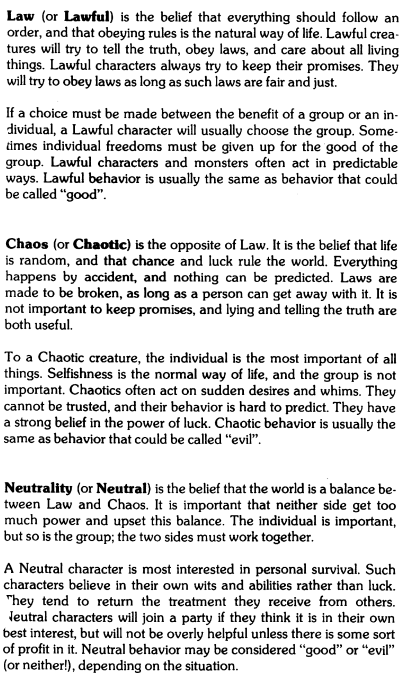
There are many interesting things you can pick out of these descriptions of the alignments. Notably that, against popular belief and teachings, “Lawful behavior is usually the same as behavior that could be called “good”.” and “Chaotic behavior is usually the same as behavior that could be called “evil”.”.
Is it no surprise that players immediately assume that Law = Good and Chaos = Evil?
Looking at Neutrality it essentially details that they attempt to bring balance between the forces and that they’re more interested in their personal survival. With them being more self-preserving you could honestly conflate the selfish behavior of a Chaotic character with that of a Neutral character.
This doesn’t help the stereotype of Chaotic player characters being Le Randumbz xD and doing party destructive behavior and being a nuisance to everyone else playing.
The example of Chaos exemplifies every problem people have with the Chaotic Thief archetype that steals from other players and murders NPCs for no reason outside of “that’s what my alignment would do”. It just feels like an in-universe excuse for characters to act in-humane and likewise for Law but in the opposite perspective.
I cannot imagine a scenario where anybody but a Lawful/Neutral or an entirely Lawful party can cooperate (if obeying alignment and roleplaying) to achieve any sort of goal without distrusting one another or having internal party fighting.
Later on the same page it mentions the application of Alignment Languages and a character’s intelligence score dictating their behavior.
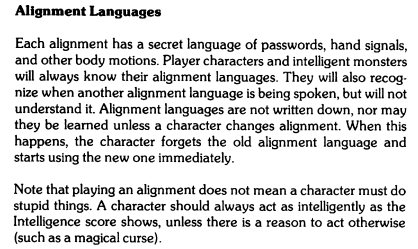
The paragraph ends saying ” Note that playing an alignment does not mean a character must do stupid things. A character should always act as intelligently as the Intelligence score shows, unless there is a reason to act otherwise (such as a magical curse).”. Saying >Should always act> implies that although Intelligence doesn’t affect much of the character besides known languages, that it should impact the character’s decision making and thought processes. The book literally gives an out for players who love to do stupid things a reason to sabotage the party, and OSR is ABSOLUTELY LAUDED AS A PLAYER SKILL ORIENTED GAME STYLE. Too bad you rolled a 3 for Intelligence, your character would never buy or utilize the 10′ Pole that OSR fans rave about in order to avoid traps. On top of that, the higher your Intelligence it seems the less you’d act like any specific alignment.
I’d imagine characters who are very intelligent lean towards Neutrality the most as it’s the most self preserving and doesn’t lock you into being simple-mindedly Lawful or stupidly Chaotic. Neutral characters by the book do to others as you would have them do to you, which in a hostile environment like a dungeon seems the most logical of decisions.
Now with all of this cynical talk out of the way – you can argue that playing a certain alignment isn’t about logic but is more about fun and living out a fantasy character who’s just insane or overtly righteous and there’s nothing particularly wrong with that but it does seem to conflict with OSR teachings and modern perspectives of intended play established now.
MY SOLUTION IS – My 2×2 Alignment Grid
Order / Freedom
Altruism / Egoism (or Virtuous/Decadent)
With this alignment system, it’s a lot easier to understand where a character is at mentally vs. Law/Chaos/Neutrality. It feels more fluid to use also, as it’s easier to separate characters by their Altruism or Egoism. Altruistic characters would be more reliable in a party and although Egoism is the exact opposite of Altruism, it isn’t explicitly 100% selfish. I imagine a character who’s Freedom/Egoism isn’t going to be nearly as destructive as a Chaotic character (or Chaotic Neutral or Evil in a 9 alignment system). Characters who are Altruistic aren’t explicitly good either, as they could only be Altruistic to their friends or their cause (Order or Freedom).
All of this to say that alignment doesn’t impact major game mechanics like it usually does, with Chaotic people being more easily slain by Lawful spells and swords. This can be adjusted to affect monsters that fall into said category ultimately, such as Faeries, Demons and Undead being pure Chaos and Angels, Modrons and Sphynx’s being pure Law so that spells like Detect Evil and the like aren’t rendered useless.
I understand now that with the origins of Law, Neutrality and Chaos being from Poul Anderson’s Three Hearts and Three Lions series, having the alignments be depicted as Law representing the good/human wellbeing and chaos being trickery and evil. However, Michael Moorcock’s perspective of cosmic forces that are struggling for balance over universes is a very awesome concept and despite my complaints can be used when running D&D, but most players see them only in their perspective of categorizable personality traits. My alignment grid more easily fits the personality board style descriptors as it’s less about cosmic red and blue teams and more about what you’d do if a gun was held to your head.
Anyways – this is all I got left in the think tank when it comes to this topic at this time. I appreciate everyone tuning in to read and all my friends who give them a skim when I shoot them links.
Thanks guys. -Dylan
 Dyl's Thrills